
 WWW
 Haku
 Jäsenet
 Kalenteri
 Apuja
 Portaali


23-01-2016, 08:11
My11 TD4 manual has earth cable attached from factory to starter bolt. Back to negative terminal via rubber boot at front of battery box
http://www.freel2.com/forum/topic16694-135.html


Update, albeit a few years later . . . .
The extra engine earth lead I put in place and wrote about a few years back have behaved themselves faultlessly, and I have never seen the HDC faults appear since.
The other day, I started to notice another starting problem. I would press the START button, and it seemed as though there was a slightly longer time delay before the motor kicked in. Probably less than a second, but enough for me to notice that there was some hesitancy there. Engine would always start without fail, but I started to listen carefully and noticed that it was indeed a little hesitant. It sounded like the first quarter turn of the starter was very slow, and then it would burst into life, almost as though the battery was flat.
The Battery was good and fully charged, and being a bit smug about my previous repair, I knew that the earth fault was well and truly fixed, which meant that my starter motor was probably on its way out. These things do happen, and they do wear out. I thought I would have a close look to see what sort of job changing it would be, and made a bit of a startling discovery.
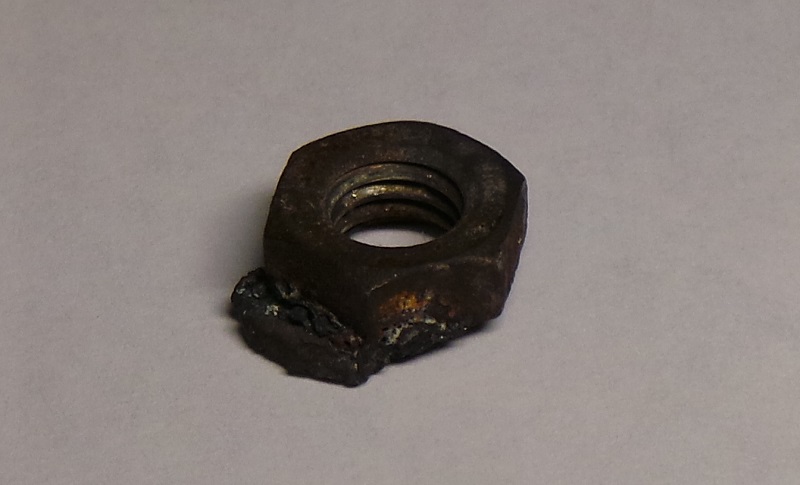
The positive lead from the battery attaches to the starter motor on the top, via a big 13mm nut, and mine looked a little discoloured. With battery disconnected, I thought I would take a closer look. Although you can just about see the nut with a torch, you are best to remove the air box so you can get your elbow in there with a spanner. Removal of the corroded nut showed that the electrical connectivity had been so poor that every time the joint had sparked, it had resulted in a lump forming on the side where it was trying to effectively weld itself to the cable.
The ring terminal on the supply cable was just as corroded, but after a few minutes with a bit of emery paper, everything was bright and shiney once more. A new nut and washer attached, and I have never heard the starter motor turn so fast. A nice and simple 10 minute fix, and a quick bit of preventative maintenance for anyone reading here.
Anyone who plays with car electrics, (myself included), will always look for an earth fault when something goes wrong, as in 99.9% of the time, that`s what it will be. Just don`t overlook the live side of things, as they can also be problematic too.
Näistä vissii voi jokanen päätellä itse , pakko se on ruveta värkkää tätäki kuha jaksaa!
http://www.freel2.com/forum/topic16694-135.html
Update, albeit a few years later . . . .
The extra engine earth lead I put in place and wrote about a few years back have behaved themselves faultlessly, and I have never seen the HDC faults appear since.
The other day, I started to notice another starting problem. I would press the START button, and it seemed as though there was a slightly longer time delay before the motor kicked in. Probably less than a second, but enough for me to notice that there was some hesitancy there. Engine would always start without fail, but I started to listen carefully and noticed that it was indeed a little hesitant. It sounded like the first quarter turn of the starter was very slow, and then it would burst into life, almost as though the battery was flat.
The Battery was good and fully charged, and being a bit smug about my previous repair, I knew that the earth fault was well and truly fixed, which meant that my starter motor was probably on its way out. These things do happen, and they do wear out. I thought I would have a close look to see what sort of job changing it would be, and made a bit of a startling discovery.
The positive lead from the battery attaches to the starter motor on the top, via a big 13mm nut, and mine looked a little discoloured. With battery disconnected, I thought I would take a closer look. Although you can just about see the nut with a torch, you are best to remove the air box so you can get your elbow in there with a spanner. Removal of the corroded nut showed that the electrical connectivity had been so poor that every time the joint had sparked, it had resulted in a lump forming on the side where it was trying to effectively weld itself to the cable.
The ring terminal on the supply cable was just as corroded, but after a few minutes with a bit of emery paper, everything was bright and shiney once more. A new nut and washer attached, and I have never heard the starter motor turn so fast. A nice and simple 10 minute fix, and a quick bit of preventative maintenance for anyone reading here.
Anyone who plays with car electrics, (myself included), will always look for an earth fault when something goes wrong, as in 99.9% of the time, that`s what it will be. Just don`t overlook the live side of things, as they can also be problematic too.
Näistä vissii voi jokanen päätellä itse
, pakko se on ruveta värkkää tätäki kuha jaksaa!